Tuesday How To: Naming Characters

There are several schools of thought on naming characters. Some say to name your characters names that are common every day names. Others say to name them special names that will stick in your readers’ heads. Still others tell you to always use name books and find the exact meaning of each of your characters names, while others say it doesn’t matter.

Being a writer for over a decade now, I know a thing or two about characters and naming them. I have had such name mistakes as Anna, Annaleigh, Anna Lee and Annabelle in the same story, as the same character (She was an orphan that preferred to change her name with every new person she lived with; I was thirteen and thought it added depth to her character, and a plot obstacle apparently), characters with such “out there” names as Blodwyn and Kendrick and Dr. Sweetcheeks McGee (ok, that last one was because I was crunched for time during NaNoWriMo), and last but not least, characters with full names every mention such as Timothy Jameson Weatherly and Nurse Kate Cooper. I am more than qualified to tell you how not to name characters.

So how do you know what to do and not to do when naming characters? How do you navigate all of the advice and tips floating around the Internet and Writing Self-Help?

Here’s the advice that works best for me.

Do:

Have Varying Letters and Lengths
If you are writing a story with Joe, Jim, Jon and Jen, your readers might have a problem distinguishing your characters from one another. If Joe and Jim are roommates and Joe is Jon’s brother, who is dating Jen, but Jen is sleeping with Joe on Tuesdays and Jim on Saturdays, your readers will be confused. Likewise, if you have Sarah, Steve, Stacy and Steph. This is due to the way we read and interpret words.
Remember when you were a kid and learning to read? How you would focus on every letter to sound out words? How often do you do that now? Rarely, right? This is because the more you read, the less you focus on deciphering the words and the more your eye focuses on the general shape. If you have character names with the same letters and lengths, the reader will not necessarily read the right names in the right spots.
The fix is easy though. Vary the letters used and the lengths of names. Instead of Barry, Barney, Benny and Bart, try Steph, Barry, Dan, and Patricia. This makes it much easier on the reader, and you as the writer.

Have Some Uniqueness
When you name characters Bob Smith, Joe Brown and Jim Jones, you are robbing your characters of the chance to have unique names. Close your eyes and imagine what image comes to mind when you think of characters with those names. I don’t know about you, but I think office clone, living in a cubicle, with no interesting qualities. If this is your aim as a writer, perfect. If not, well, there are easy changes to make.
You can name your characters basic names like Jim, Joe and Bob, or use last names like Smith, Jones and Brown, but don’t use them together. Or if you do use them together, use them as a placeholder until you find better names in edits. Instead of Bob Smith, use Bob Kowalski, or Bob Lycster. If you want to use a common last name like Smith, combine it with a less common first name, like Hazel or Bridgetta. Or you vould even change the spelling of common names for a little more zest. Vary it up and your readers will thank you.

Pick Your Initials Carefully
This one should be self explanatory, but you would be surprised how easy it is to not think about it. I have had characters with the initials A.S.S. more than once, usually by marriage, or E.W. for the initials of a first and last name. While these are not the worst of errors when naming characters, it is important to consider when naming characters, or even a set of characters.
If Anna Sarah Wiley is going to marry Samuel Sands, you should probably change one or both names, unless your purpose is to make an ass of your character. Likewise, if you have first and last name with the initials E.W. such as Eric West, add a middle name. It won’t always work,  unless you have a reason for using the character’s full name, but it will help. Eric West becomes Eric Richard West.
It’s best to avoid naming blunders with initials, but they can be augmented if you are set on certain names.

Don’t:

Name your Characters the Same Name, or Variations of the Same Name
In the example above with Anna, Annaleigh, Anna Lee and Annabelle, it definitely confuses the reader. Yes, it is the same character,  and yes, she does change her name a lot, but this does not excuse the fact that your readers will probably be annoyed with you.  If your character has to change names (which I would use with caution, unless you are writing a spy/espionage piece), use varying identities. Your writing should not be like the comics “Oh, you have glasses on, you’re Clark Kent today”; in writing that would be “Oh, you changed one letter that augments the pronunciation,  you are obviously not Anna Lee”.  Do your readers a favor and vary it more than just a few letters.

Have too Many Apostrophes or Unique Characters
This applies to you fantasy writers mostly, but has basis in all writing. Please, for the love of all that is holy, don’t name your character An’que’mon’lea or Reñńøldâ. The first example is semi ok, if you shorten it to a nickname and use the full name sparingly, but the second is just asking for trouble. Your readers will spend more time trying to pronounce it than reading your work, and you want people to read your book. Instead, use unique characters and apostrophes carefully.
My general rule is one special character or apostrophe per name, or even per piece. Too much of a good thing can get confusing.

Use Too Many Names
This is a your mileage may vary tip. If your story calls for it, if your character’s culture calls for multiple names, or they are royalty, go ahead and use a lot of names, just not everytime your character is mentioned. Once or twice, sure. But not every time. Shorten Maria Renee Kathetine Reynaud De Espinosa Coorezando to Maria or Marie.
This will add word count if you are focusing on count and not content, but multiple names are a pain in the ass to type out every single time.

So there you have it. Some tips on naming characters. As always, these are not rules, more guidelines. If your piece calls for or a long name, or similar names, or any of the above rules, by all means, go for it.

Happy Writing!
Tuesday How To: Finding Characters

Writing without characters is like riding a bike without wheels, you won’t get too far. Sure, there are pieces out there that have limited characters, but they at least have one aspect that has to do with the development of a personality or skills. Look at Disney/Pixar’s Wall-E. There is no dialogue for the first half of the movie, but Wall-E and Eve have personalities and show some growth before the rest of the characters are introduced.

Characters are easy for some people, and difficult for others. Depending on the piece, characters could come easily, or they could hide from you for the first ten or more pages. I have had several experiences with characters, from my first story with the protagonist that had more than ten names, to my most recent characters who grow and become more alive with every new draft of my novels.

So this first installment we are going to talk about finding  characters. So let’s jump to it, shall we?

Depending on what your current project is, you could already have your characters. If you write fanfiction, which is writing based on someone else’s characters and setting, you already have your characters. If you are writing from scratch, you might not have any characters, or maybe just a few.

How you find characters will depend on if you have an idea or not. Sometimes characters, or their names will come first, and then their plots or ideas come after. Sometimes you have the idea and you just want to shake your character and scream at them “Tell me your name!”. Either way, I would like to believe characters want to be discovered.

With an Idea

If you started with an idea, I think the task of finding characters is easier. With an idea, and whatever parts of a plot you already have, fitting a character where they are needed becomes a bit easier. For instance, say we have the idea for a plot surrounding a bank robbery. The character we need can either work with the idea surrounding a bank robbery or be against it. What I mean by that is: Our character can have several personalities depending on the plot. Is the character part of the robbery, or just in the bank when the robbery starts? Does our character try to stop it, or just cower in the corner, crying for their mother? Make the character fit what you need the character to be.

An example that I have used in the past is the Camp NaNoWriMo April session. I was writing a novel based on someone falling into the addiction of drugs. I could have gone the easy way and said the character was male, twenty-four years old, was traumatized as a child and addicted to alcohol, but that is what readers would have expected, that seems to be the stereotype of drug dealers and users. What I ended up doing instead was making her female, type A, in medical school, and selling drugs without using them. This made her interesting, and went against all stereotypes.

Without an Idea

Coming up with characters on their own is definitely hard. Without the backbone of a plot, characters could be anything. Sometimes, characters come to me with their full names and their stories, but most of the time it’s like an awkward first date trying to pull information from them. There have only been a few instances where I come up with the character before the idea.

One of them is Georgia Rose Howell. This is a name that came to me in a flash of inspiration without an idea attached to it. I have tried several times to add her to other working ideas, but she refuses. She seems to be holding out for her own work, but she won’t give me any more information than just her name. She’s like Groot in that way.

Me: What’s your story?

GRH: I am Georgia Rose Howell.

Yeah, eventually I’ll find a place for her, but for now, she’s just a fancy name.

Next week, we’ll talk about naming characters and bringing them to life.

Happy Writing!

Handwriting and Typing

There are several ways to get our words and ideas out into the universe. If you are a singer, that’s through music; an artist, it’s through paint or marble; a politician, your words and actions. If you are a writer, however, it’s through one of two mediums: handwriting or typing.

There are several reasons to do one, or the other, or even both. Though with the addition of wireless technology and the internet almost anywhere, handwriting and even cursive, are beginning to become obsolete.

I was lucky. I experienced most my childhood before the big influx of technology, and most of my early writing days were with a pen or pencil and blue lined binder paper. It wasn’t until my teen years that I even had a personal computer. I can still think back to when I did some of my school assignments that required typing at my kitchen table on an electric typewriter from the early 80s. If I hadn’t had that personal computer, I would probably still be using that ancient monster.

I am still lucky. I have loads of technology, and several ways to stay connected, several ways to get my words on the page whether through a keyboard on a touchscreen or writing each individual word on a blue lined page. I am lucky to have that choice, to choose how I want to write it and how much work I want to put into it. I’d like to think I’m not alone in that choice.

There are several choices out there, whether you handwrite in notebooks, or if you choose technology to get your words on a page. This isn’t going to be a post where I give you my best choices for writing utensils or programs, it’s not going to be a post where I try and persuade you that one is better than the other.

This is just a way to say that both are valid options.

I actually handwrite and type, depending on the project. If it is a project that requires multiple drafts, I usually handwrite the first draft, and then type subsequent drafts. I find that this helps because with handwriting there are less distractions. Usually when I type, I get distracted by the idea of checking my email, or my facebook, or my blog, but handwriting it’s a bit harder to get distracted.

When I work on second drafts or rewrites, then I type. It’s easier to read the words and determine what I was trying to say if it’s a relatively clean page, free of notes or doodles. It also keeps the page cleaner, rather than trying to look through the scribbles and determine my meaning.

It shocks me that people my age, and people even older, wonder why I handwrite a lot of the time. I understand that everyone has their smartphones and iPads and technology right at their fingertips, but at the moment, I don’t. I can’t always connect to the internet to write down my every thought, or feeling, so I handwrite it. I actually prefer it that way. That means I can go write outside without trying to see a screen in the bright sunlight, or I can go where there is no internet or service and still write.

I’m not saying that everyone should go back to handwriting, or that everyone should use technology. What I am saying is: Change it up. Don’t get caught up in one way or another. Disconnect from the mass of technology that is the internet and try writing a few words with a pen, or put down the pen and start typing a page or two. Change it up, especially if you’re stuck, because you never know what can happen.

In the end, it doesn’t matter how you do it, just as long as you keep writing.

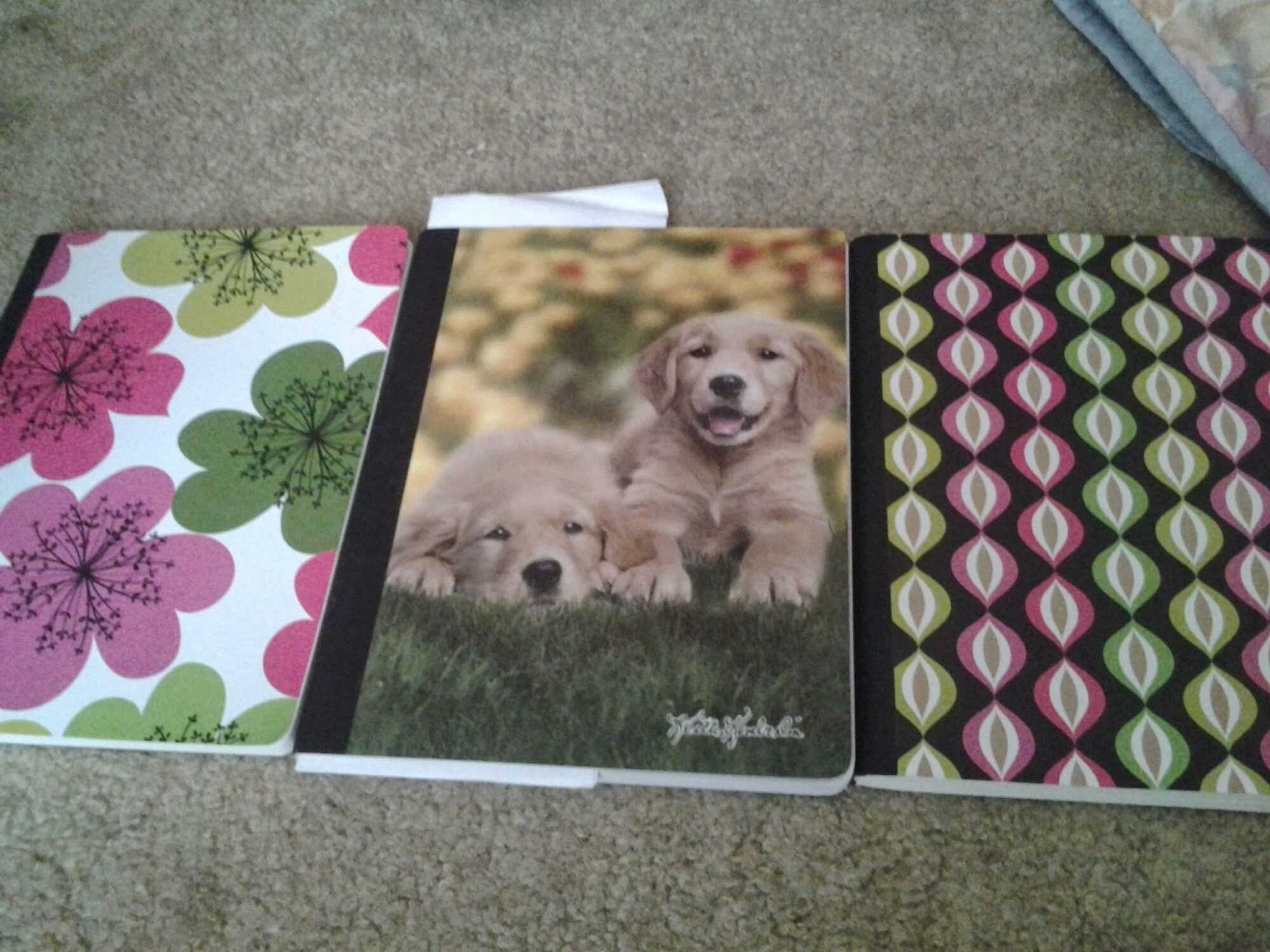
Notebooks like the ones I use to handwrite

How do you write your words?