Five Reasons You Should Do NaNoWriMo This November

Ahhh November, the changing of the seasons, pumpkin spice everywhere, the feel of family in the air. And for several writers, National Novel Writing Month, NaNoWriMo. If you haven’t heard of it, or are not sure what that jumble of letters is, or if you should participate at all:

Here’s five reasons you should participate this November.

1. New project time!
We all have projects we want to start, but we feel we never have the time, or never have the right words to start. With NaNoWriMo, there is no time to debate whether the words are right or the timing is right. On midnight November 1st, it’s time to jump in and get words on that page. It’s a chance to start something new and leave your doubts in the dust by writing words without judgement.

2. It’s less than 2000 words a day to 50K
The actual number is 1667, that’s actually a lot less than 2000. But on the other hand, writing over the daily count of 1667 will help you to win earlier than November 30th. And if you think about how many words 1667 words is, that’s not even that much, especially if any words will do. And if you get stuck, or you’re not sure what to write, there’s always the forums.

3. Support from forum and writing buddies
While NaNoWriMo is a self challenge, it doesn’t mean you have to do it alone. On the website, there are forums, pep talks from writers and editors, and other writers competing to reach 50,000 words before the clock strikes midnight on December 1st. There is a ton of support and so many people wanting you to succeed in your novel.

4. You never know what can happen
You may start with something on the fly, not sure if it will ever become something, or if it will just grace your desk drawer like a dirty secret, but you won’t know unless you keep writing it, and keep learning what your characters have to tell you. Whether you plot or not, writing is an adventure, and your characters may lead you to places you never imagined. You could finish your novel and it could become a best seller one day, or even part of a series. The possibilities are endless!

5. You can say you wrote a novel!
You! Yes, you can say you wrote a novel. Whether you finish it or not, write 50K or not, continue it after until you reach the words “The End”. You can still say that you wrote a novel. It’s a great conversation starter, and a great accomplishment. You should be proud of your accomplishments whether you reach 50K or not. And you will have more words on December 1st than you did on November 1st.

So why not check it out? Here
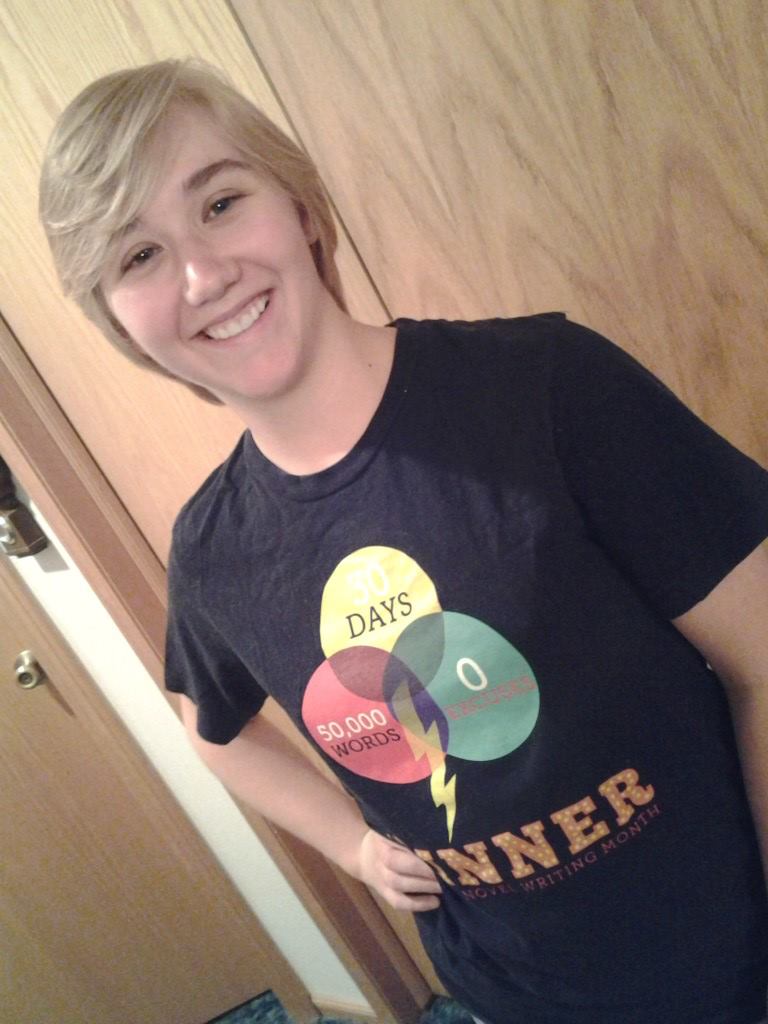
More perks: Merchandise!

What have you got to lose? Why not try NaNo this year?

Want to be my writing buddy this year? Here

Tuesday How to: Write Developed Characters

 Hello Readers! Special Message here: If I seem short during this Tuesday,  blame WordPress. I had been working on this post for more than a week, almost 2000 words put into it, and then WordPress decided to be a butt and delete it all. So here is attempt number two!

Some writers will tell you that naming characters is the hardest part. To develop them all you have to do is write out their story and their arc, then edit it in later drafts. I think that it really depends on the character. Whether or not their arc is a wide sweeping arc or a simple event that sets their actions. Being a writer, and having several characters, I can tell you that sometimes their arcs come easy, and then other times it will be several drafts in and I will be staring at a blank page thinking “Who the hell are you? What the F*@K do you want?”

To write developed characters, with complete arcs and growth, there are three things to keep in mind: Backstory, Mid-story and post story.

Backstory

Backstory is important, but not always relevant to the specific scene you’re writing. You should make it match your character, but not too obvious that the reader feels like they were fooled. Unless your character is the luckiest person in the world, everything is not going to just fall into their lap. They have to work to get where they are when your story starts. They have to have failures and successes. Not just one or the other.

Depending on your story and your character arc, your backstory determines how your character will react to certain situations in your plot. If your character is in a bank robbery, whether they are a trained soldier, or a guy who adamantly hates guns and violence will change how they react to the gunmen.

Mid-Story

In the middle of the action, your characters decisions determine their growth and their arc. There are generally two reactions to growth in story. Your character can either accept the changes, or fight them tooth and nail. There are a thousand choices, several types of growth, but it all basically boils down to “I accept this” or “Not in a million years”.

The most important thing in Mid-Story character development is consistency. If your character encounters a barking dog at the beginning of the story and is scared of it, then if they encounter the dog again in the middle and are not scared, there better have been some kind of growth in between.

Post Story

Post Story is probably the least important development, but it is still important. Unless your character dies at the end of your work, or they are braindead, they still have to grow after the events of the story. Post story is more important if you are working on a series, but for stand-alone is still relevant.

Post Story is what happens “after the credits”. The hero has saved the girl (or vice versa), the evil baddie has been taken care of and all is well. So what are the hero/ girl’s plans after? Some choose to let the reader decide, hence the “Rides off into the sunset” ending. Still, some others add in small hints throughout the piece. Like for instance, your character loves knitting and is working on a blanket, but they are pulled into this elaborate plot against the president. “ALL I WANT IS TO FINISH MY DAMN BLANKET!” is repeated several times in your piece.

Post story they better finish their damn blanket.

No matter what your plot or your character arcs, do your best to keep them consistent and your characters will be well developed and readers will thank you for it!

Happy Writing!

Writing Out of Order

Rarely ever do writers write like actors portraying writers in movies. In movies, there is just one draft, no hardship, no long nights editing and crying because you can’t remember how to spell an easy word, no agonizing wait times. Just shiny finished product. Movies make writing seem like the easiest thing in the world, they makes great sentences seem effortless. Actual writers know that is not the case.

Every writer is different. How they write, where they write, how many pages they write a day. The list really goes on and on. There are some writers that start at chapter one (or the prologue) and write through the whole book. There are writers that never write anything in a coherent order and shuffle the scenes around at will. I used to write straight through, chapter one until the end, but more recently, I’ve been able to jump around a bit.

I’ve been writing a series for about four years now. I started with book one, wrote a very little bit of book two, and even less of books three and four. The series is going to be a long one (I hope) of between seven and nine books. This gives me a lot of material to work with and a lot of chapters to write. The only novel I’ve completely finished (besides major edits of the latest draft) is book one. I’ve actually rewritten it 3 separate times, tweaking a different aspect each draft.

Let me tell you, three time writing the same basic plot can be BOOOOORING! So in the latest draft, I wrote out of order for the first time ever. I had my outline, and the plot and characters that I knew so well, and I would like to say it worked. I’m too close to it right now, so it’s waiting to be viewed by a few others before I do anything else.

Since I am writing a series, I can jump around and write other parts while I wait for book one to be readable again. As I said, I’ve worked on a few other parts of the series, writing parts that I felt I couldn’t keep inside anymore, or parts that related to book one.

There are several reasons to jump around, whether you’re writing a long series or just one stand-alone book. Sometimes, scenes toward the middle or end of the plot are more interesting; maybe there’s just one scene that is the epitome of your idea and you have to write it down before it’s gone forever. While there are several reasons to jump around, there are some things you should keep in mind.

Keep an Open Mind about the Scene
The scene could come out just as you see it in your head, or there could be a word or a phrase that sets you off in a different direction, or maybe even ten different directions. Just write notes about your ideas as you write and even scenes it could connect to later. It’s also good practice to keep in mind that the scene could move around, or even be cut entirely based on the finished product. It could even be edited to something that barely resembles the original. There are a million and one possibilities.

Think About Your Outline
Or your idea if you don’t have an outline. Think about where it will go in your novel or whatever you are writing, think about the scene that comes directly before or after, where your characters need to be, what they know, or what they don’t know. This can always be added later, but it is good to think about before you jump in blind.

Write Like You Know Everything
When you write out of order, you might not know all of the small detail throughout your project. You can know the big picture, big scenes and plots, but subplots and transitional scenes might not be as solid. Even if you don’t know it all, write like anything is possible. Write like every detail is already in place and that you know exactly what happens next. Remember, you can always edit it later. Nothing is set in stone.

When you jump around in your piece, whether it’s a novel, script, or anything else, you can learn more about what comes before and after that scene. Whether it’s the same book or not. When I finished book one, there was almost a whole section that seemed off to me, and I couldn’t put my finger on it. As soon as I started writing the same section for book two, it became clear what was wrong. In book one, I wasn’t sure what to expect, what needed to be there, and exactly what I was getting myself into. In book two, the character perspective was more advanced and the character knew more about the world around him. I knew his goals better, they were more solid and that made it easier to write book two, and even rewrite the part of book one.

The outlines and notes for the whole series. It's always good to write down your ideas, even if they seem stupid or weird at the time.

I have a little assignment for all of you. If you’re thinking about writing, or even have something started, but not finished, finish the scene you’re on, and then write the ending. Yes, you read that right. Write the ending. Just try it out, see how it feels, especially if you’re stuck in your current project.

If you attempted my little assignment: How did it work for you? Did you like it, or was it the worst thing in the world?

How do you write your projects? In order, or do you jump all around?

Five Reasons You Should do Camp NaNoWrimo This April

Every year, writers, both old and new, get together to participate in Camp NaNoWriMo. Camp NaNoWriMo takes place several months out of the year and allows anyone to write a novel. April used to be for Scriptfrenzy, but now it’s all about the camp life, cabins, writing buddies, and writing a novel in 30 short days.

Here are some reasons why you should try Camp NaNoWriMo this April:

1. It’s a great start for a new project
If you are a writer, or even if you’re not, you could become one this April. Ever have that nagging idea that wants to be written, but you just never find the right time or place? Camp NaNo will give you that time, and the place could be anywhere. Even if it’s not a new project and just a rewrite, you can still have that rush of trying to make word count and the accountability of writing your novel. Either way, you get words on a page.

2. You can pick your own goal
Unlike NaNoWrimo (which is in November) where the word count is always 50,000 to win, in Camp NaNoWriMo, you can choose your own goal. Want to stay on par with NaNo and write 50,000 words? Go for it! Want to smash 50K and go for the big 100K? You can do that too! Scared of the 50 and want to go for something a bit less daunting? Go for 25K or 15K. You can put any number in that box. You can choose whatever you want. AND you can change it throughout the month, no matter what your progress so far.

3. Less busy time than November
Ahh, November, the time of writing a novel, getting together with family, and FINALS IN A WEEK?! If that sounds familiar, whether you are a student, or you have other events coming up in December that induce the same fear as finals, then Camp NaNoWriMo may be a better fit than its parent event. Since April is earlier in the year, and not so close to holidays and more stressful times of the year, it’s a bit less stressful to sit down and write. There aren’t as many tasks that need to be completed before the end of the year, and not as many family members around all up in your space. This makes noveling way less stressful.

4. Less holidays in April
Depending on the year, few major holidays are in April. Sometimes Easter falls in April, but that’s better than Veteran’s Day, Thanksgiving, and Black Friday, and the rest of your family in your daily life for a week or more. In addition to less holidays and distractions, the weather is starting to get nice and inspiration is blooming outside, along with our moods.

5. More Choices
In addition to getting to choose your own word count, you can also choose your cabin mates. There are several ways you can choose them, or you can randomize it and meet all new people. The choice is yours, you can even choose to not have a cabin at all.

There are a lot more choices associated with Camp NaNoWriMo, so it would be a great introduction to NaNoWriMo and what it and the Office of Letters and Light are all about. You could win, or not, but you will definitely end the month with more words than you started with.

So why not try?

Camp NaNoWriMo: Here

Handwrite or type, just get some words down for Camp NaNoWriMo

What do you think about Camp NaNoWriMo? Are you going to participate?

Writer Life Lesson #2: Write What You Want

Fads are everywhere. Things become popular one day and are gone the next. Writing is no stranger to fads and popular ideas are everywhere. When one idea becomes popular several copies follow. Think about how popular vampires have been, or dystopian novels. Where one pops up, five more follow. In five or ten years we’ll all be moved on to a new overused plot or trope.

This leads me to Writer Life Lesson #2: Write What You Want

There are several reasons why you should write what YOU want. If you are writing to please someone else, or because popular fads get published, or you just want to make money, you are doing it for the wrong reasons. It may work out for a short time, but in the long run it is career and passion suicide. It will get tiresome and boring and you will hate it.

On the other hand, wonderful things happen if you write for yourself and what you want to write. Every piece will get your heart pumping and your hands itching to write just one more scene.To write what you want, to write for yourself, is one of the greatest gifts you can give yourself.

Write your work and your ideas, no matter what the popular fad of the week is. It’s easy to want to fall into a fad, to get ourselves thinking “Well the best selling novel right now is about werewolves so I am going to write a book about werewolves and make it big!”, and yes, anyone could make it big writing about werewolves, but that doesn’t mean the werewolf fad will always be popular.

Publishing a novel takes a long time. With the weeks to wait to hear back from publishers and agents, weeks for rewrites and edits, more weeks after that for formatting, cover design and PR, but the time your book hits the shelves it could be a year and a half or more. Think about where you were a year and a half ago, think about what was popular then and what is popular now. Back to the werewolf example, if werewolves are still popular in a year and a half to two years, your book is probably catching the tail end of that wave. Your book will get some sales, but slowly be phased out with the rest.

I’ve fallen into the same trap. I wrote a vampire novel, and a werewolf novel, or parts of them anyway. They ended up being scrapped pretty quickly. Might I finish them eventually, or rewrite them entirely? Maybe, but now is not the right time. I’m a bit embarrassed to admit this, but I even wrote a novel with basically the same plot as Twilight, or it started out that way. Toward the end it became its own plot and had it’s own themes. When I rewrote it about a year later, it became much better. That piece is still in the works, and it may be published someday, but only after I can give it the proper time it needs.

Which leads me to my next point: If you feel you must write something that is considered a fad, change it up enough, make it as different as you can, give readers something they don’t expect to keep them reading. Fads go out of style because we, as a society, get used to them, they become boring and trite. If you can surprise the reader, show them a new side or something they didn’t consider, they will keep reading.

Back to writing for yourself, what you want to write, and publishing. If you write something that you didn’t choose or something that you think will make you money, remember it is something you will have to keep revisiting. Something that will continue to need work and edits and rewrites. It’s not something you can just write once and send in expecting it to be perfect. If you write something you love working on, something you love to revisit like an old friend, it will be easier and more fun.

And isn’t that what writing is supposed to be about?

My favorite work so far. And the piece I keep revisiting.

What is your favorite piece you’ve written so far? What was it about?