NaNoWriMo 2023 Week One Update

Usually for NaNoWriMo, I go all out and just write with abandon (which is part of their motto), in a frantic race toward the end. This year, I’m doing something a little different.

I want to try and find out what makes November so successful for me. Is it the high of starting a new project? Is it the time spent focusing on writing and not social media or other distractions on my phone? Is it simply the magic of November?

This year, I’ve decided to track my minutes and hours written and my word count for the day. I want to know how long it takes me to reach par (1667 words) a day and how to continue something like that into 2024 and hopefully much longer than that.

Lately, writing and editing and working on every project has felt like a chore and I’m hoping to take what I learn this month in November and find the joy of writing again.

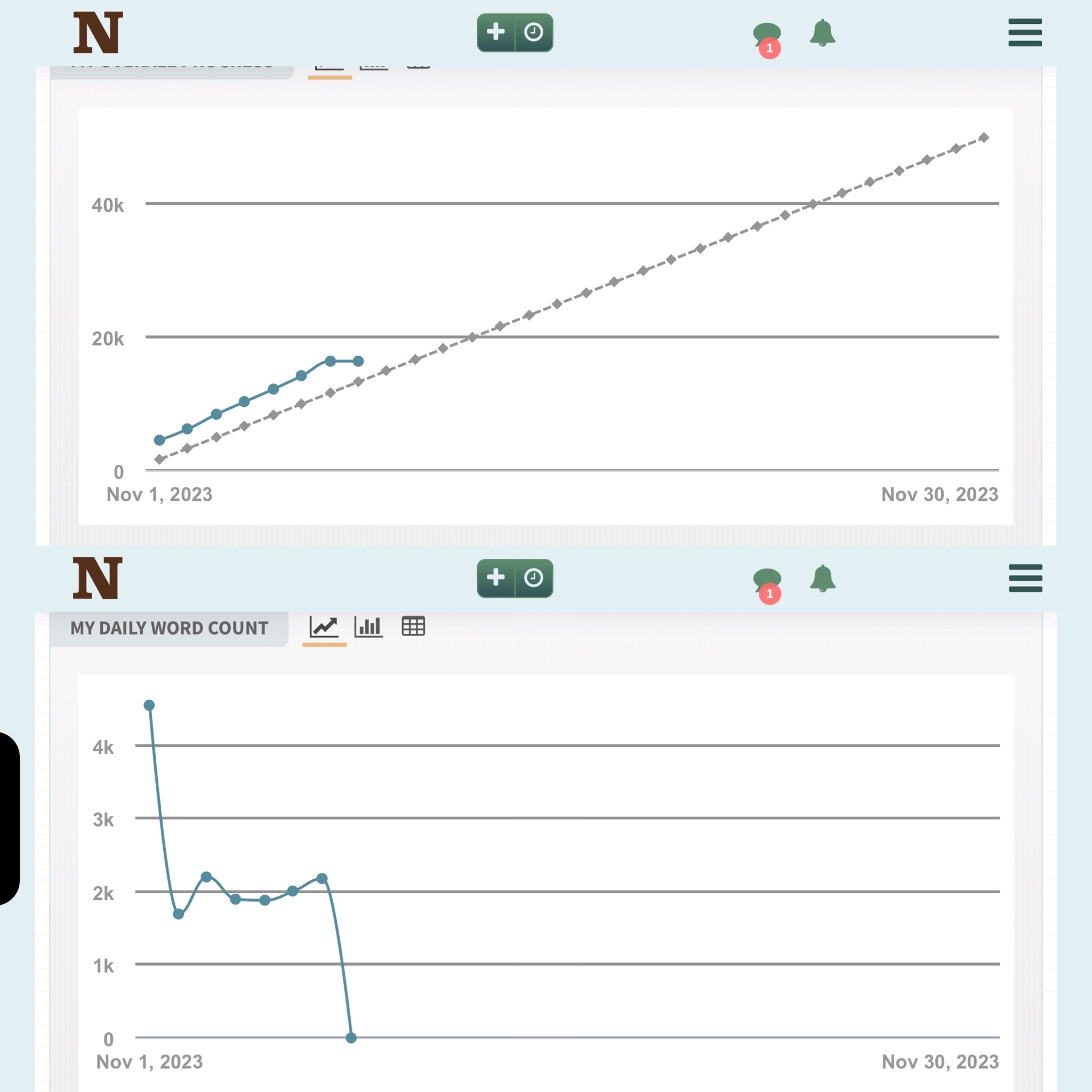
Here’s how I’ve done in the first week of NaNoWriMo and the first 16,409/50,000 of To Have a Heart.

Day One

Day one is usually always the best day of NaNoWriMo. I’ve spent the last few weeks pumping myself up to get some writing started and when midnight hits, I go without a care in the world. This year, I’m doing something different and tracking my words and the time spent writing.

I started at midnight, despite the exhaustion and got about 200 words. I kept pushing throughout the day (with timers ranging between 5 and 15 minutes). I also went to a write-in for my region.

4,549 Words in 2 hours and 45 minutes.

Day Two

Day two was a lot of world building and struggling with names. I felt like I needed to research, but pushed through and kept writing. Research is something I can do in December or when the full story is completed (which I am also hoping is in December.

1,694 words in 40 minutes

Day Three

Day three was the first day I went back to work after NaNoWriMo had started. I was fortunate to get the first two days off without asking for them and it was a great jumpstart to the novel. Day three was not the best writing day, especially with distractions from work, but it could have been worse.

2,200 words in 50 minutes.

Day Four

Day four was the first day I had off together with my husband and the writing was a bit slow to start with more distractions of spending time together and catching up after our week of work. It wasn’t the best writing day, but I did still manage to reach par (1,667). Day four was when I decided I am going to strive for par every single day of the month and get ALL the badges on the NaNoWriMo site.

1,897 words in 40 minutes.

Day Five

Day Five was a busy day and not because of writing. There was a lot of running around, thankfully all of it fun on a day off with Wine Tasting and delicious food. This was the first day I feared I wouldn’t make par, but thankfully long car trips and small breaks in between really saved the day.

1,882 in 1 hour and 12 minutes.

Day Six

Day Six was another day back at work. I always try to get started with the daily count in the morning (especially since the first few hundred words are the hardest on a new day). On day six it was a struggle. Still, I persevered and made writing a priority even though distractions were calling my name. I also started to go off outline a little because for some reason I put a crucial scene and character way down in the outline and realized I could introduce her way earlier.

2,008 words in 47 minutes

Day Seven

Day Seven was another work day, a little busier, but also a little more freedom to get writing done in a strange way. The novel is really starting to get interesting, even though I feel like I started it too early before the real plot kicks in, but world building and a day in the life of a main character still counts for words, so that will be an editing problem once draft one is finished.

2,179 words in 45 minutes.

Overall Breakdown

I timed myself for every writing session I completed for this week in order to decode the magic of November and how I fare so well when writing during NaNoWriMo. I used both my computer and my phone because I rarely sit in one place when I write.

Overall, both computer and phone time were pretty close to equal with only about an hour and a half more on the computer, which surprised me with how much time I felt like I was writing on my phone .

4.5 hours average on my computer for the week and just under 3 hours on the phone.

In just over 7.5 hours, I wrote 16,409 words, which is 33% of the goal toward 50,000.

So far, November is going really well.

I have another write-in tonight, which should be a great boost for my word count, but I think Wednesdays this month will probably be my best days. I’ve learned a lot over this week analyzing my writing habits.

Tune in next week!


November Results and December Goals

November was a strange mix of fast and slow, creativity and drought, and work and play. It’s hard to believe it’s already over and we’re now in the last month of 2020.

Here’s how my month went and how much I accomplished:

November Results:

NaNoWriMo

NaNoWriMo 2020 went great as far as the straight challenge goes. I did reach 50K and “won”, but I did not reach my personal goal of 60K (or 2K/day). I did get nearly 75% through the plot though, so I’m taking it as a win.

Finish Several Open Projects

Not much progress was made on any other projects besides my NaNo project this year, but I planned for this goal to work through December too.

Read One Book

I actually did this one! I read The Invisible Life of Addie LaRue by V.E. Schwab and I absolutely loved it. Reading books has always been a favorite activity of mine, but I have never seemed to have enough time. It was really great being able to return to it.

Word Total: 54,182

December Goals:

Finish My NaNoWriMo 2020 Project

As I said, I got a good portion through the plot during November, and I would really like to finish it before the end of 2020.

Finish Several Open Projects

I have several novels and short stories to get through by the end of the calendar year, so I can start fresh once 2020 is over. I’m hoping I’ll make decent progress in these pieces (Ghost House Heart, Fan fiction part 3, and a few miscellaneous others) during the month of November and into December.

Read One Book

I’m hoping to get some time away from writing and refill the tank and read something new. I’m working through something nonfiction for the first time in a while, so we’ll have to see how that goes.

Personal Growth

The month of November has shown me I need to make some changes and do some growing and changing if I want to have the life I strive for. I’m not entirely sure yet what personal growth will include, but stay tuned!

November was really productive and I hope the streak continues in December!

Writer Life Lesson #27: Make Writing Work For You

Most of us who call ourselves writers are often more than just writers. We have day jobs, hobbies, families, pets, and probably a thousand possibilities for distraction every second of every day. Sometimes, writing can seem impossible.

This last month, I wrote for Camp NaNoWriMo and for the first two thirds of the month, I struggled. I was thousands of words behind on my goals and writing wasn’t working, so I found time and I made it work.

How I did that was to Make Writing Work For Me (not the other way around).

Making writing work for you is possible when you do what is best for you.

For instance, I knew I had signed up for Camp NaNoWriMo with one project, but I knew I needed to finish a draft of a novel, so I tried working on both, but it wasn’t working, so I put one aside and worked until I finished the draft.

Another way you can make writing work for you is to follow what advice works for you best.

There is all kinds of writing advice out there for new writers, and honestly not all of it is the greatest. If you can write every day AND stay focused on one project for long periods of time AND make a writing schedule AND everything else that is popular writing advice, good for you! I’ve tried it, and I’ve beat myself up when I can’t do it, and that only makes writing seem more like a chore.

Sometimes I follow the advice, and sometimes I don’t. That’s how I make writing work for me.

Writing should be fun! It’s your writing craft, so make it work for you.

April Results and May Goals

Well, another month of writing and goals done. April is always a bit of a tough month for me, with difficult anniversaries, but it ended up working out well in the end.

Goals from April:

  • Camp NaNoWriMo: 40,180
  • Ghost House Heart: 14,770
  • I finished Under Grey Skies with a total of 138,799 words and 11,247 words of notes. ( with 24,501 words during Camp NaNo)

Goals for May

  • Continue Ghost House Heart
  • Start Editing previous books in the series
  • Write 30,000 words of anything and everything (Look out for new blog content!)
This month was hit and miss to start, but in the end I smashed goals!
Finally, after months, this beast is complete.

Camp NaNoWriMo News

Hello Everyone! April is just around the corner, and that means Camp NaNoWriMo!

This year, I’m working on two projects. Finishing up my project from NaNoWriMo 2019, and starting a new project.

Under Grey Skies: Doing my best to finish up my 2019 NaNo Novel by the end of April.

Book Nine of the LOVED series.

Earth: There are no more children to save. There are no more lost souls to wake. Everything should be perfect, but Jared has disappeared, and Qu has been set to wander the earth. The only person that can stop him is Emily. Chasing Qu, she runs into someone she never expected. 

Widren: With Qu gone, the island and the city have become what they were meant to be, a paradise. Randa must find the boy, but no one can help her. He’s a mystery that might just stay a mystery forever.

He was always in the background, never thought of himself as anything special, but she saw him.  

GOAL: Write “The End”

—–

Ghost House Heart: Death is only the beginning. When Blanche loses her fiance in a tragic accident, she thinks there is nothing left for her. Until she learns there may be a way to bring him back. Now she will do anything to bring him back, even if it means risking her own life. 

GOAL: 30,000 words.

This Camp NaNoWriMo will definitely be interesting, since I’ve never worked on two projects at full speed like this before and even with the chaos of the world, I’m still working full time.

Wish me luck!

(There’s still time to join me for Camp NaNoWriMo Here, just create a project and link it to the event. I’m always looking for more buddies, this is Me.)

August Results and September Plans

August Results

August has been a very interesting month for writing. I’ve been distracted by a fewcthins here and there and working on a few projects that have been super fun this month.

  • The Kiss: 25737
  • Seven short pieces for Hidge Week (You can start with Day One): 3507
  • LE poetry (Winter Here): 40
  • Fanfiction: 2890

Total: 32174

This month was fun for writing and continuing my goals for writing at least a few words daily. I wrote every single day of August. There was one day I ended up writing 3 words. Other days I was able to write 3,000. It all depended on the day and what ended up popping up to distract me.

September Plans

September is quickly approaching and that means fall is on the way! With the seasons changing that means November (and NaNoWriMo) is on the way.

Here are my plans for September:

  • Getting things planned and organizing events for NaNoWriMo in my area.
  • Participating in Instawrimo on Instagram
  • Finishing The Kiss
  • Attending my first writing conference ever at the Central Coast Writer’s Conference.

September is going to be fun!

NaNoWriMo: What it Means and What it Stands For

Every November, millions of people write as many words as they can in an attempt to form their very own novel. They find the time between work, school, family, holidays and sometimes life in general, to attempt to reach 50,000 words. Many of them succeed in the first day, and many of them blast past the measly 50,000 and write so much more in the entire month. Since it started in July 1999, NaNoWriMo has been going strong. I’ve been participating since 2009 and I absolutely love it.

But what exactly is NaNoWriMo, and why do so many people participate?

NaNoWriMo, short for National Novel Writing Month, is a non-profit, mostly website run event by the Office of Letters and Light, that takes place in the month of November. Every year, the goal is to reach 50,000 words in any way possible, whether writing stories, a full length novel, or anything else with words on a page. While there are some rules and regulations, it is mostly a self based challenge, and goes by the honor code when counting daily word counts, until it is actually validated. The event may only last for the month of November, but the website and all of the great resources on the website (the forums, the profiles, the shop and many other goodies) stay up all year.

There are several other programs run by the Office of Letters and Light, such as Camp NaNoWrimo and Script Frenzy (while the website is no longer up, it does continue in the forums). The events are hosted usually in the summer months and occasionally April as well. There is a website but the parent is the NaNoWriMo site.

Why is NaNo important?

I have been a writer for most of my life, but I haven’t always taken it totally serious until recent years. I wrote all through middle school and high school with no problems, but when I started college in 2009, I felt like I lost my writing mojo. I couldn’t find any serious ideas and I suffered from the worst kind of writer’s block. Every piece I started just felt like crap. I had just come off finishing the longest novel I had ever written at just under 500 pages, a great script I had written over the summer, and I felt like my writing talent had just fizzled out, like I had used it up and it would never come back. I was depressed and in the biggest writing funk of my life.

And then I found out about NaNoWriMo.

I first found out about NaNo in September or October of that year, and I signed up almost as soon as I found the website. I didn’t have a novel yet, but by the time November rolled around, I knew I would. I ended up writing a rewrite of the novel I had started in 2008 and that was a good honest first effort. I did not win, or even get close to 50,000, but the lessons it taught me and the fun I had writing only caring about the quantity instead of the quality, was well worth the effort.

NaNo is so important because unlike every other writing challenge, it doesn’t care about the beauty of the words, just that there are words. This transition was tricky at first, because I was so used to being a perfectionist before, and even in my first attempt. I edited a lot during that first NaNo and that was why I didn’t get as far. NaNo focuses more on the act of actual writing rather than the act of polishing your writing for something better. NaNo knows that the first draft doesn’t have to be perfect and that it’s ok for it to suck.

I have continued to compete in NaNoWriMo every year since 2009 and to be honest, I don’t think I will ever stop. There is just something about having an idea and writing those words and sentences and paragraphs down that make up that idea without caring if they make sense that is just so freeing. Sure, sometimes I look back and make a disgusted face, or actually cringe at some of my word phrasing and choices, but it’s all in good fun, and is by no means permanently stuck in one way or another. Edits can always come later, just after November.

There are some naysayers out there that think NaNoWriMo is stupid, or a waste of time and that people should be reading books instead of writing them, and that December is terrible because people send off their unedited NaNo novels to publishers. I have to say, I honestly don’t understand it. It’s not like it’s out to hurt people or that it’s going to sully the act of writing. Just because people are writing new books doesn’t mean yours will be magically unpublished or cease to exist. People will still read books, even if they are writing their own. As far as the argument that December is terrible because people send their unedited works and that NaNoWriMo is the cause is a really bad excuse. I don’t think I know anyone who would send their NaNo off the first of December because most of them aren’t even finished by then. Blaming NaNoWriMo for something that it isn’t responsible for is backhanded and rude.

I actually had someone say to me when I told them about NaNo “That’s stupid. I would rather focus on quality and write a great piece instead of quantity and have crap.” If that technique works for you and you want to focus on quality words, great! Why are you putting down any method of writing? The result is the same whether you write one word a day or a thousand, you have words on a page. NaNo is just a way to break past the block of “What if my words aren’t good enough?” and finally finish something for once.

There will always be people who don’t want to see people succeed, or who don’t want to see people have fun in writing. I say, why not do it? It’s not going to hurt if you try. If you hate it, I’m sorry, maybe writing under pressure isn’t your thing. If you like it, that’s awesome!

So I want you all to do two things for me:

1. Check out NaNoWriMo: Here and Camp NaNoWriMo: Here
2. If you like it, think it’s interesting, sign up!

I hope to see you this November!

Note: If you do sign up, be my writing buddy: Here

What are your thoughts on NaNoWriMo?

What I’m Writing: Camp NaNoWriMo

This year, in both April and July, hundreds of thousands of people will be writing a novel in a month. Each one of those hundreds of thousands of people will write their own novel, whether it be five pages or five hundred. Fingers will be flying, pens will be scribbling and writers will be writing.

I will be one of those writers, and I finally have my plan for this April. This will actually be my first serious attempt at Camp NaNoWriMo that is not a rewrite, or that doesn’t coincide with finals, or resesrch papers. Plainly, this is the first April where I will have time to write what I want, and give it the attention it needs.

So what am I writing this April?

The Thirteenth Step

Details are still a bit sketchy, like names and details. The basic premise is a med student who falls down the spiral of addiction after turning to selling drugs to pay tuition.

Stay tuned for updates!

Are you going to try Camp NaNoWriMo this April? What are you writing?

Writer Life Lesson #3: Write Every Day

Imagine your writing, whether it be a work in progress, or an essay,or a bunch of short stories, or even all of the above. Now think about your day, the errands you run, or what hours you work, or the time you spend doing things you really want to do. Is writing anywhere in that day, or is it just something you do when the urge hits you? It should be something scheduled, or at least planned.

Writing Life Lesson #3: Write Every Day

We, as writers, are lucky. Our hobby, or our job as a writer is not expensive. It isn’t as expensive as say, gambling or skydriving. If worse came to worse, we could all write on 50 cent notebooks and dollar store pens. The most expensive thing that writing requires is our time.

Writing anything takes time. Sure, the idea may come in a flash, but the actual writing takes time. Each word carefully crafted from our minds to the pen or pencil or keyboard, each sentence and paragraph strung together with time and energy.

Some days, it’s hard for us to write, the ideas just don’t come to us or we are distracted by something else more pressing. Those are the days we need to write most. Writing is a muscle, it requires working out every once in a while. Any athlete will tell you that to make something stronger, to hone a skill, it must be practiced and performed. No one wakes up and is the best writer in the world, just like no athlete or physicist wakes up and is the best in their field.

When we as writers take time to write every day, whether it’s a to-do list, or a chapter, or even just an idea or two in detail, we work those writing muscles and make ourselves better writers. We practice that skill and we get better at putting words on the page and making sure those words are the right words we want to say to get our point across. Our stories, or our blog posts or whatever we write grows into something we ourselves could never have imagined we would make. We impress even ourselves, and that is magical.

So how do we get ourselves to write every day, especially if it’s a struggle? Make every word count. Actively think about the words you are writing or what they mean to you, or will mean to someone else. Start small, 5 or 10 minutes a day, and then slowly increase it to 15 or 20 minutes. Write wherever you can find time, or write in long chunks, it doesn’t matter, as long as you keep writing.

It will get easier as it goes on, so why not start today?

These are my daily word counts for February. This is the longest writing streak I've had in a while.

What does your writing schedule look like? Do you write every day?

Ideas and Where to Find Them

Ideas are everywhere, and can come from anything. Pictures, songs, shows, everyday conversation, anyone and anything can spark an idea. Sometimes, the more ideas you find, the more that keep popping up when you least expect them. Sometimes, all we need to do to find ideas is look, listen and feel the world all around us. Ideas are everywhere if you just stop forcing yourself to look for them and let them find you.

Over the years, I have found ideas from many places and turned them into some decent drafts, and some not so decent drafts. Some ideas lead to great works, and others fall through, but they all deserve a chance to be explored and experimented with. They deserve to be given a chance to show their brilliance.

I’ve mentioned before that my first serious idea came from my eighth grade history class, when my awesome teacher started talking about the new colonies of America and indentured servants. I have thought up several ideas from other classes, but I find a lot of my ideas in several places.

Sometimes it will be something said in conversation, or a scene from a play or movie, sometimes it’s a game, or even another novel, or short story. Sometimes it’s social media and sometimes it’s even a song or several songs. Sometimes it’s just a simple image.

My second novel I ever completed was based off of a picture. It was a school assignment, one of the last assignments in freshman year english, and it was supposed to be just a short story. That was what it stayed, a short story about a boy in love with his best friend (this seems to be a common theme in my writing), and they died at the end because I didn’t know how to end it. It stayed that way until my junior year when I found it hiding on my computer and decided it wasn’t done. So an idea came from an idea. That piece still needs a lot of work, but I at least I finished it.

More recently, my ideas come from songs. If you just happen to take a peek at my short stories page, you’ll notice they are all song titles at this point. I have always had a love of music ever since I was a young child. Sometimes as I lay in bed at night listening to any kind of music, I jolt out of bed and have to write a new idea down based on a lyric or an instrumental or both. Some of the short stories turn out amazing (Amsterdam, Congratulations, The Scientist and Samson come to mind) and some fall flat, but they become words on a page and can always be fixed later, they can always become something more.

My current novel, which has recently grown into a nine book series, got its start from a book of prompts. There were a few that were similar that I pieced together and augmented as needed. It started as just a girl in a coma close to death after a serious accident, and then became a three book series, and then a seven book series, and finally a nine book series, pulling several ideas from pretty much everywhere as it grew.

That is the power of ideas and what they can become.

The longest short story to date, and it all came from parts of a song.

Where do you find most of your ideas?

Writer Life Lesson #2: Write What You Want

Fads are everywhere. Things become popular one day and are gone the next. Writing is no stranger to fads and popular ideas are everywhere. When one idea becomes popular several copies follow. Think about how popular vampires have been, or dystopian novels. Where one pops up, five more follow. In five or ten years we’ll all be moved on to a new overused plot or trope.

This leads me to Writer Life Lesson #2: Write What You Want

There are several reasons why you should write what YOU want. If you are writing to please someone else, or because popular fads get published, or you just want to make money, you are doing it for the wrong reasons. It may work out for a short time, but in the long run it is career and passion suicide. It will get tiresome and boring and you will hate it.

On the other hand, wonderful things happen if you write for yourself and what you want to write. Every piece will get your heart pumping and your hands itching to write just one more scene.To write what you want, to write for yourself, is one of the greatest gifts you can give yourself.

Write your work and your ideas, no matter what the popular fad of the week is. It’s easy to want to fall into a fad, to get ourselves thinking “Well the best selling novel right now is about werewolves so I am going to write a book about werewolves and make it big!”, and yes, anyone could make it big writing about werewolves, but that doesn’t mean the werewolf fad will always be popular.

Publishing a novel takes a long time. With the weeks to wait to hear back from publishers and agents, weeks for rewrites and edits, more weeks after that for formatting, cover design and PR, but the time your book hits the shelves it could be a year and a half or more. Think about where you were a year and a half ago, think about what was popular then and what is popular now. Back to the werewolf example, if werewolves are still popular in a year and a half to two years, your book is probably catching the tail end of that wave. Your book will get some sales, but slowly be phased out with the rest.

I’ve fallen into the same trap. I wrote a vampire novel, and a werewolf novel, or parts of them anyway. They ended up being scrapped pretty quickly. Might I finish them eventually, or rewrite them entirely? Maybe, but now is not the right time. I’m a bit embarrassed to admit this, but I even wrote a novel with basically the same plot as Twilight, or it started out that way. Toward the end it became its own plot and had it’s own themes. When I rewrote it about a year later, it became much better. That piece is still in the works, and it may be published someday, but only after I can give it the proper time it needs.

Which leads me to my next point: If you feel you must write something that is considered a fad, change it up enough, make it as different as you can, give readers something they don’t expect to keep them reading. Fads go out of style because we, as a society, get used to them, they become boring and trite. If you can surprise the reader, show them a new side or something they didn’t consider, they will keep reading.

Back to writing for yourself, what you want to write, and publishing. If you write something that you didn’t choose or something that you think will make you money, remember it is something you will have to keep revisiting. Something that will continue to need work and edits and rewrites. It’s not something you can just write once and send in expecting it to be perfect. If you write something you love working on, something you love to revisit like an old friend, it will be easier and more fun.

And isn’t that what writing is supposed to be about?

My favorite work so far. And the piece I keep revisiting.

What is your favorite piece you’ve written so far? What was it about?

Doubt and Writing

If I had a dollar for every time I doubted an idea, I would be rich, and not have a single word written, nor any novels or short stories completed. Plainly, I would not be a writer, but a doubter.

Every writer, at some point or another, doubts their work, their ideas or their talent. So what do you do when that nagging doubt starts to eat away at your precious writing time? The way I see it, you can do three things. You can feed it, you can ignore it, or you can write through it.

If you:

Feed It: You let it grow. You let it eat away at you and fill you with fear and the idea that you are nothing, that you will never be anything because your idea is stupid, or it’s already been done by much better writers than you. It tells you all you do is copy, all you will ever be is a copier and a scam. No one will ever read your book, even if you paid them. I could go on and on, but you get the point.

If you:

Ignore It: You don’t listen to your doubts, you don’t let them get you down. If you can write, it goes well for a while;If you cannot write, you can’t come up with a reason why. You keep telling yourself I’ll write later or I’ll write on the commercials. It’s never I don’t want to write it’s I just can’t write right now. Eventually, your doubt sneaks up on you and it’s impossible to ignore it. And you suddenly find yourself listening to it.

If you:

Write Through It: You don’t listen to your doubts, you don’t even hear them because you are busy putting words on the page. You learn that your doubts are not all bad, and some of them are even founded, but that you take them with a grain of salt. You realize that your doubts were a way to try and keep you down, keep you in the same place you were and away from change. You keep writing even though you have doubts and you get pieces done. Instead of your enemies, your doubts become some kind of friends, or at least warnings.

I used to be in the first category, and then I moved into the second category the longer I wrote. I would write, but I would have all of those doubts and it would take ages to even finish a piece. I would focus more on other things I wanted to do instead of writing. Paint drying could be more interesting. I would start pieces and never finish them. I would start pieces and get stuck and not even want to get unstuck. I thought I was ignoring my doubts, but they were still eating me.

Recently, if you can call just over two years ago recently, I began to start taking writing more seriously than in previous years. I began taking everything more serious in my life when I got accepted into the Licensed Vocational Nursing Program. Around that time, the first manuscript I ever typed was printed for me. That, and the fact that my mom and almost her whole side of the family read it, and actually liked it, propelled me into the third category.

Even though I had doubted myself and told myself no one would read it or like it throughout the whole writing and typing process, someone had liked it. It was then that I realized, even if I doubted it almost every step of the way, it didn’t mean that my doubts were founded. That was when it all changed and I decided to write through my doubts and not let them eat me alive.

I’m not saying that’s the way for everyone, but I am saying that just because you doubt yourself doesn’t mean that you shouldn’t write that idea or plan it out. What you could do is write in spite of the doubts.

It may seem difficult at first, but it will get easier. Start by taking a deep breath and focusing on the project before you. Then write one sentence, it doesn’t even have to be a good sentence. Just one sentence.

How about you? How do you handle your doubts?

This quote is great. Think about your doubts as those brick walls.

And remember, the secret is: Just keep going.

Productive Writing Days: I Finished My Goals, Now What?

My goals for November of 2014. That would have been almost 3 whole novels in one month, during nursing school finals and internship. That was too many goals for such a short time.

Sometimes we finish things ahead of schedule. We reach goals that we thought would take us longer than they did, or we give ourselves a long while until the deadline just in case life gets in the way. Sometimes we need all that time, but sometimes we don’t.

Yesterday, technically today, a little after midnight, I finished my second chapter for the month of February and I wrote the short story for February in about 2 hours. Yesterday was a very productive writing day, and that’s a good thing. What’s not so good about that is that I completed my writing goals for the month in just two weeks. I underestimated the time and effort it would take to complete those goals.

Now I have two options. I can relax for the rest of the month, focus on writing essays for my class and studying for my license test, or I can write the next chapters, the ones that were supposed to be for next month, and another short story, and perhaps finish more goals ahead of schedule. This should be an obvious choice, since one of my goals is to write every day, and I think after writing every day for a solid month straight, I would be bored if I just stopped.

I am going to continue to write, both chapters and short stories, and maybe finish some of my long term goals ahead of schedule. Instead of waiting for two weeks to continue and halting my momentum, I am going to continue the momentum and continue the inspiration. I am going to put my time to good use and finish something instead of waiting until the last minute like I’ve had to do for so long.

It looks like it’s going to be a great writing year. And that is a welcome relief after the writing years I had the last two years. With Nursing School and all of the intense focus and other priorities, I kept having to set back my writing goals and write when everything else was completed first. Now that I have more free time, and just one online class this semester, I have more time to seriously pursue my goals while I wait for the next stage of my life to begin.

Deadlines can change and that is acceptable. Sometimes we have to push them back month after month after month, and sometimes we finish them way ahead of time. Either way, keep at them. If they are important, they will find a way to be completed. Sometimes it’s in one sitting and sometimes it’s in five minute segments over two or three years. As long as the goal doesn’t change, the deadline can be flexible.

I did graduate nursing school in December 2014, despite my lofty goals in November.

So whether you are ahead of schedule, or behind, keep at it. Something beautiful can come of it if you continue. Enjoy the journey, and what it has to teach you.

How do you set deadlines for yourself?

Goals for 2015

I’ve done a lot of talking about goals, and how important they are, but I haven’t really shared any of mine yet. I suppose this post would hold more importance around the new year, but goals can and should be considered all the time. The new year is a great reason to start new goals, but it shouldn’t be the only reason.

My goals for 2015 are:

1. Write every day- This goal should be pretty obvious. I am a writer and if I want to continue to be a writer, I should take it seriously and write. I have tried this goal several times, for several years, but something always gets in the way. So far, I have missed a few days here and there, but I am not perfect, nor do I claim to be. Since starting this goal in the middle of January, I have written around 20K total.

2. Finish the second book in my series- I started the second book, Little Earthquakes: The Child, in November of 2012 (Thanks, NaNo!). The end of that year and the beginning of 2013 were very stressful for me, and I barely even touched the surface of the second book. After editing and rewriting parts of the first book, the plots of book two changed into something better. Since I finished the third draft of book one, it’s time to let that rest and give some life to book two.

3. Edit the first book in the series- I began the first book, Spark: The Girl, in November of 2011 (Thank you, NaNo!) and I had parts of a plot, but not any ideas strong enough for a whole series (which it quickly became). After finishing the first draft, and realizing the holes and the several changes it needed, I began to write draft two, which then became draft three after several more realizations. Now that draft three is done and complete, it’s time to try something new and edit it thoroughly and start looking for a publisher. Maybe even draft four too.

4. Write a short story every month- I used to struggle with short stories. I figured why write a short story when you could write a whole novel? I began my first short story in April of 2013, to challenge myself, and I actually ended up liking it. I decided when 2014 rolled around to do a short story a month. I managed to write nine short stories and start a tenth before 2015 started. I liked it so much last year that I’m doing it again this year. Not only does it flex my creative muscles, but it gives me the option to work on something else if I get stuck in a novel.

5. Send something out for a contest and/or publishing- This was one of my goals last year. I expected to be finished with the third draft way sooner than I actually finished it, and I was going to edit it quickly, find an agent and a publisher and have it published by the end of the year. That didn’t happen and to be honest, I’m quite glad. It would have been a complete mess. However, what did happen was way better. I found out about a short story contest and submitted what I thought was my best work. I didn’t win or anything special, but at least I tried. It was frightening at first, to say the least, but the confidence boost afterward was one of the best gifts ever. I plan to do something like that again this year.

Now that I’ve shared mine, what are some of your goals?

Writer Life Lesson #1: Write It Down

Being a writer means writing, but sometimes writing doesn’t come as easy as we might like. Sometimes the ideas don’t come flowing as a raging waterfall splashing the exact words we want on the page. Sometimes they show up when we have no way of remembering. Sometimes the ideas keep us up at night, or catch us right between sleep and awake and the next morning we don’t remember them.

The best way to combat all of these problems is to write it down!

If the ideas don’t come as easy as we would like, or if the ideas are there, but we’re scared of the words, terrified with the fear that the words will be the worst ever, the only solution is to write through it. It doesn’t matter if the words are “I don’t know what to write” or “Hitler was such a jackass”. It doesn’t matter if they connect to what you were writing or not, just write your first thought, as soon as you pick up that pen or open that document. If the first words you write suck, or are outrageous, the pressure to find the right words will be lessened. If after that first thought, you’re still stuck, keep doing it until you find the right words. You can always go back and edit it (or laugh about it later).

If you have the exact opposite problem, and get ideas when you can’t write them down or keep them long enough to remember them, find a mental image wherever you are, something you’ll remember like an orange penguin eating purple pancakes, or imagine the thought over and over and over again as many times as you can until you get the chance to write it down. If you have a pen, but no paper, write it on your hand or wrist or wherever it will stay until you can write it down somewhere permanently. If the same think occurs at night, and you don’t or can’t turn on a light, I recommend a small whiteboard, or something you can grab quickly in the dark and jot down the idea before it flies away.

White board above my bed. Several ideas live there

So whether the ideas won’t come, or they won’t stop coming: Write it down. No matter how dumb it seems at the time, you never know when you can recycle it later, or turn it into something else.

After all, some of the craziest ideas make the best stories.

How do you keep track of your ideas?