Writing is hard. A lot of readers just think words on a page means instant book, but we writers know that is far from the truth. Writing takes editing, editing takes time and rewrites. Words rarely end up on the page and stay where they are in the first draft. Sometimes, the whole process of writing can be exhausting.
This week’s lesson is: Work at Your Own Pace
This month, I am working on Camp NaNoWriMo, and to be honest, it’s not going as well as I would like. I am supposed to be writing at least 1667 words a day, and my average for the first week is much lower than it should be. But I am not here to complain about how my novel is going this month.
Working at your own pace is important. Sure, some writers write a complete novel in a month, edit it the next month, rewrite the month after that, and on and on until they have a complete novel. That paces is just dizzying to me. Some months, I can barely even get 1000 words on a page let alone 1 word. Some months, days, and even years can just be plain hard. The usual advice is “Write Every Day” or “Write Through Your Doubts”, but those are general tips, by authors and bloggers that don’t know you personally.
There are instances where it is better to write at your own pace. I can think of several instances that I can think of where waiting and not forcing it is much better for my writing. There are several instances where if I had rushed it, the work would suck and need so much more editing later.
Sometimes writing is easy, but a lot of the time it’s not. Some days writing is the hardest thing in the world, and that is totally ok. Writing every day is best to build a routine, but it doesn’t always work. So try your best to write daily, but some days it just doesn’t happen.
When it doesn’t happen, don’t beat yourself up. There will be days, or sometimes even weeks, sometimes longer where you don’t write. When that does happen, try to figure out why you can’t or don’t want to write. Sometimes it’s as easy as “I am stressed” or “I am more interested in doing something else”. One that I face occasionally is “I don’t like where I left off on that page” or “I don’t know whay words to put down”. If you can’t find a reason or it’s just not happening, try and think about where you want to go with your piece or a scene that you want to write and jump around.
If none of that works, try writing one simple sentence. Whatever comes to mind, story related or not.
Happy Writing!
What is your general writing pace?
If you are participating in Camp NaNoWriMo, how is your word count looking?
Being a writer could mean anything. It’s a quite large umbrella term, just like artist or scientist. Like any other label, what we use as writers, or artists, or scientists defines us. Writer could mean anything from articles to webblogging and anything inbetween. There are many tools that we as writers use, whether it be programs, or specific devices or inks. Anything that helps us get those words down on the page, or whatever mediym we decide to use, makes us writers.
Our choices in the tools we use says a lot about us, a lot about our circumstances, and a lot about our preferences. We can consistently stick with one medium, or we can use several at a time. The choices are endless, and I suspect they will be forever changing.
When I started writing, I used a pencil and a spiral bound notebook. It worked at the time, especially since I had just started eighth grade and still felt more comfortable with a pencil than a pen, since I had been using only pencils since I learned how to write. It worked for a while, but then I began to notice that the pencil rubbed off and made the pages ashy and unreadable in certain areas. Not only that, but the metal spirals would get crunched and never remain quite viable enough to prevent the ripping of pages. If I wanted to preserve my writing, so I could continue to read it, and work with it, something had to change.
So I switched to ballpoint pens, and I went through several brands before I found one I actually enjoyed writing with every time. It took a few rounds of trial and error to find which pen didn’t leak through to the other side of the page, or bleed at just the slightest humidity, making the page look messy, or which pens would scratch through the pages with just the slightest change in pressure or ink. It took several rounds of pen buying, and pen tossing before I found the best fit for me.
A little background on my handwriting “posture”. I am left-handed (which means I pretty much always smudge), and I balance the pen on my ring finger rather than my middle finger. Using my ring finger as a balance gives me more support from my thumb, fore finger and middle finger, but that also means I can write pretty heavy on the page at times.
The pens that work best for me, and that I love are the R.S.V.P. by Pentel. They have a grip to support my fingers and prevent me from gripping too hard and writting too heavy, they have great ink flow and last a pretty long time (depending on how much I write), they have a clear plastic, so I can actually watch the ink and not be too surprised when I run out, and they come apart easy so I can replace the cartridge when needed. Not only that, but the ink stays where I want it on the page, with no bleeding or fading and it looks amazing. They come in several different ink colors, and sizes, which makes the choices practically endless, and you can even “build your own” as I like to call it. Currently, I have a purple grip and an electric blue topper, and I just replace the ink cartridge when it runs out.
As for notebooks, I used spiralbound for several years, just dealing with the crunched metal spirals and the hazzards that came with it. I was used to ripped pages, small jabs, notebooks stuck together, and many other hazzards that presented themselves. After all, the writing inside was still readable, and spiral bound were the cheapest and easiest. And then I found the non-spiral bound. The notebooks with the smooth edge and the pages that had no change to get ripped when turned on the warped spirals. So I bought a few, and tried them out. I liked them, but the only problem was in my area therer were few of them sold. Finally, after years and years of not seeing them, and still using spiral bound, or loose leaf paper in a binder (with lots of those reinforcement stickers, and staples), I came across composition notebooks.
I started using composition notebooks for all of my writing toward the end of 2010 and I absolutely loved them. No spirals to get warped or catch my hand on, no risk of pages falling out, hard cardboard cover, basically no problems, Not to mention super cheap almost year round. They also come in fun festive patterns and are easy to decorate with sharpies.
So my current tools are a composition notebook (at least 3 for each book, one for each section) and an R.S.V.P. by Pentel with several refills.
What are your handwriting tools? Why do you like them best?
Writers write. Or so you would think. Do artists art, or musicians music? Well, yes, in a way, but there is more to being a writer, artist, and musician than just a word that describes what we do. Being a writer is more than just putting words on a page, it’s also reading and editing and rewriting. Being a writer is way more than just writing.
I am a bit embarrassed to admit that I didn’t realize that for a long time during my first decade of writing. I think part of it is the media that surrounds writers. When an author comes out with a new book, we, as consumers don’t see that struggle, we don’t see the sleepless nights, and the thousand or so cups of coffee that went into fueling that masterpiece. We just see the finished product, all shiny and new with a stunning cover and a title that makes us want to read it as soon as we touch it. I think media has a lot to do with the notion that writers just write. Think of any movie that has a writer as a main character, does it show the editing process, the struggle to rewrite? Chances are, it doesn’t.
This is a huge reason why editing, and rewriting and whatever else editing entails, can be frightening. All the doubts that maybe we didn’t encounter when we wrote the first draft, can jump out at us. The improper word choices or clunky phrasing can jump out like monsters from the closet. Even the names of characters and places can make us scream like frightened children, afraid of the dark. The fear that the first draft is the best draft you can get could quite possibly eat you alive!
There is no one way to edit. It could be all your piece needs is a line edit here or there, or whole sections could need to be rewritten or scrapped. Maybe it’s everything under the sun needs to be changed, and the whole piece needs to be written from scratch. There is no “catch-all” formula for editing. It all really depends on you, and your writing, and what it means to you.
When I first started even thinking about my first novel Spark before I even augmented the title, or even realized it was meant to be a series, I wrote an outline of what I wanted including characters, places, and a bit of plot. I had planned to write the whole thing, first book, from one characters perspective, but at the last minute changed it to third person. I followed the original outline pretty closely, but found that the last chapter would be too many pages and that I still had so much to say. I ended up splitting the last chapter into four more chapters, which worked at the time. I thought I was done when I wrote those last words. Done, copy, print, send it out to an editor.
Then the book then became a series, first of three books, then of seven books, and then finally nine (or so I hope). I read through the first book again, after it was so graciously printed for me, and there were some sections that I cringed at for what felt like days. It was pretty bad for a huge chunk being written in 30 days, then left alone for nearly four months and then finished pretty quickly in the three months following. It was terrible, but I didn’t know how to edit it, what to add, what to take out, where to move things. It was a disaster.
So how do we, as writers and editors, get over our fear of editing?
The simple answer is: We dive right in.
Let it Sit For A While- Like a fine wine, let it age for a few months. Distance yourself from your piece, as strange as that may sound. Work on something else for a while, so when you return to it, you can view it as a reader instead of the author. The recommended time really depends on what the purpose is, if there is a deadline, and how long the piece is. If you spend 15 years writing an epic, you’re not going to let it sit for a month and dive right back in. Give it enough time to become interesting again so you don’t remember every plot point, character dialogue and plot twist. When you are ready, usually when you forget what it was based on the title, or forget exactly what the characters names were and why you chose them, move to the next step.
Make A Backup Copy- This step is SUPER IMPORTANT! You may think that you don’t need to make a backup copy, but let me assure you, yes you do! It may be cringe worthy, and you may never want to look at it again, but you should still keep a copy. Why? The simple answer is this: That was the original, the first draft where you just put your ideas down unedited, unfiltered. If you decide to go back, that you’ve edited too much, that you want to keep something from that first draft, you have that copy to fall back on. Finishing something is a milestone, and you should keep a copy of it, even if the first draft sucks.
Read Your Work- This step should be a no brainer. You have to read it to know how you want to fix it. And why would you not want to read the finished piece in its entirety? Especially after you’ve let it sit and age. You could surprise yourself with the ideas, or the words you added. You have a right to be proud of it, and enjoy it just as a reader would. Read it several times, make notes in the margins, read like an editor would, finding words or phrases or scenes that don’t work. After reading it through, anything can happen. The choice is yours.
There are some people out there who think that writers shouldn’t self edit their own work. I can understand why, we’re too close to our own projects, we don’t know the business as well as professional editors, we don’t know grammar and the rules as well as we should… the list is endless, but that doesn’t mean we can’t give our work a once over and make it tighter.
As writers we should learn the tools of our craft, and put our best work forward, instead of focusing only on the work of others. Sure, you could pay to have a professional editor go through your draft, but they can be pretty pricey, depending on your number of words, and it could be weeks and weeks of waiting. Why not learn a new skill yourself, and get that satisfaction of editing, and not have to wait on someone else?
Another tip: It doesn’t hurt to really be in love with your work, whatever it may be. It’s ok to put it away for a while, but make sure you want to come back to it.
That first book I was telling you about, I’m still editing it and learning as I go. Right about now, I’m about to start draft 4, which means more rewrites, but it’s getting closer to that first image of brilliance I had almost 5 years ago (And even better with editing!)
The first draft and part of the second. Still in edits, even after 4 years.
What has been your experience with editing and the fears that sometimes follow?
When we write, when we put words down on the page, we often want to be heard, we want our words to mean something. Sometimes that means just putting words on the page, and sometimes that means something huge, like publishing. Publishing is one of the best opportunities for writers, and it is a huge step, no matter what path we,as writers, choose for ourselves.
There are many options and so many choices to make when we decide to enter the publishing world. There is everything from publishing on a blog for just a few followers to sending your work to one of the big publishing companies for millions upon millions to read (if you’re lucky). In between, there are more options and so much to decide in a short amount of time. There is a lot you should know about publishing, and so much you should research for yourself. Publishing has changed so much since books began to become mass published and there are so many terms and conditions that may be confusing to first time researchers.
These are only for short story markets so far, but some do cross over to novels and non-fiction.
Simultaneous Submissions- This refers to how many submissions you send into separate publishing companies. Say you have a story called “Bob’s Lunchbox” and you think it’s the most amazing story ever so you send it to Company A, Company B and Company C. That would be a simultaneous submission and most publishing companies frown on that. They usually prefer that you wait to hear from them before you send your masterpiece somewhere else.
Multiple Submissions- This refers to how many submissions you send to that same company. This means if you have more than one great masterpiece, “Bob’s Lunchbox”, “Purple Robe”, and “Rest for Bob”, you send them all to the same company, Company A. Most publishing companies don’t like that either. They prefer you send one story at a time so they can process that one, decide what they want to do with it, and then get back to you before you submit your next piece.
Previously Published- As writers, we should know what “previously published” means, but with the internet and so many types of art becoming readily available, that definition becomes a little fuzzy. Most literary magazines, publishing companies, and online publishers define previously published as “Anything that has been distributed for audiences on websites, print, or digital”. This means on social media, writing websites, and yes, your blog. But don’t fret when you print it on your home computer, in print refers to anything with a barcode. Say, the createspace option for winners of NaNoWriMo. It may be amazing to have your book in print, but if you want to publish it, and publish it seriously for mass audiences, skip the offer.
These are just some general terms that are on most submission guidelines pages. There are probably a lot more options out there and a lot more terms to research, but these are just the tip of the iceberg. You should do your own research for your own publishing ventures and carefully decide what path you want to pursue. I am not an expert, I am a researcher, just like you, and a writer that wants to inform and protect my fellow writers.
Best of luck if you decide to publish, and best of luck in your writing!
Publishing can be scary, but you will learn a lot just by researching
Do you have plans for publishing? Where are you going to start?
If I had a dollar for every time I doubted an idea, I would be rich, and not have a single word written, nor any novels or short stories completed. Plainly, I would not be a writer, but a doubter.
Every writer, at some point or another, doubts their work, their ideas or their talent. So what do you do when that nagging doubt starts to eat away at your precious writing time? The way I see it, you can do three things. You can feed it, you can ignore it, or you can write through it.
If you:
Feed It: You let it grow. You let it eat away at you and fill you with fear and the idea that you are nothing, that you will never be anything because your idea is stupid, or it’s already been done by much better writers than you. It tells you all you do is copy, all you will ever be is a copier and a scam. No one will ever read your book, even if you paid them. I could go on and on, but you get the point.
If you:
Ignore It: You don’t listen to your doubts, you don’t let them get you down. If you can write, it goes well for a while;If you cannot write, you can’t come up with a reason why. You keep telling yourself I’ll write later or I’ll write on the commercials. It’s never I don’t want to write it’s I just can’t write right now. Eventually, your doubt sneaks up on you and it’s impossible to ignore it. And you suddenly find yourself listening to it.
If you:
Write Through It: You don’t listen to your doubts, you don’t even hear them because you are busy putting words on the page. You learn that your doubts are not all bad, and some of them are even founded, but that you take them with a grain of salt. You realize that your doubts were a way to try and keep you down, keep you in the same place you were and away from change. You keep writing even though you have doubts and you get pieces done. Instead of your enemies, your doubts become some kind of friends, or at least warnings.
I used to be in the first category, and then I moved into the second category the longer I wrote. I would write, but I would have all of those doubts and it would take ages to even finish a piece. I would focus more on other things I wanted to do instead of writing. Paint drying could be more interesting. I would start pieces and never finish them. I would start pieces and get stuck and not even want to get unstuck. I thought I was ignoring my doubts, but they were still eating me.
Recently, if you can call just over two years ago recently, I began to start taking writing more seriously than in previous years. I began taking everything more serious in my life when I got accepted into the Licensed Vocational Nursing Program. Around that time, the first manuscript I ever typed was printed for me. That, and the fact that my mom and almost her whole side of the family read it, and actually liked it, propelled me into the third category.
Even though I had doubted myself and told myself no one would read it or like it throughout the whole writing and typing process, someone had liked it. It was then that I realized, even if I doubted it almost every step of the way, it didn’t mean that my doubts were founded. That was when it all changed and I decided to write through my doubts and not let them eat me alive.
I’m not saying that’s the way for everyone, but I am saying that just because you doubt yourself doesn’t mean that you shouldn’t write that idea or plan it out. What you could do is write in spite of the doubts.
It may seem difficult at first, but it will get easier. Start by taking a deep breath and focusing on the project before you. Then write one sentence, it doesn’t even have to be a good sentence. Just one sentence.
How about you? How do you handle your doubts?
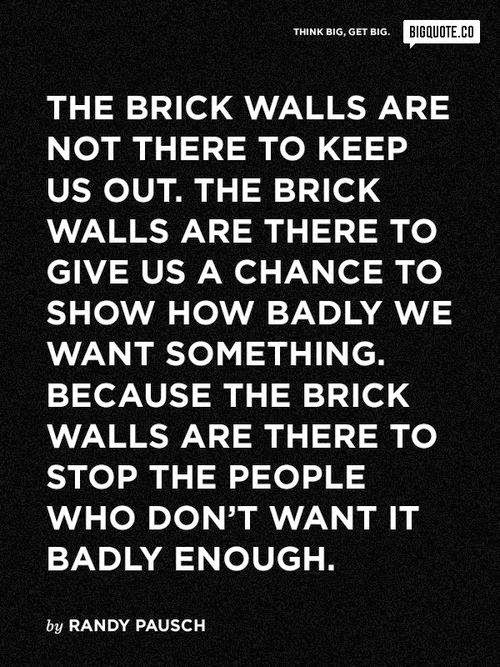
This quote is great. Think about your doubts as those brick walls.